

Vocabulary
Why is vocabulary important to children?
Teaching vocabulary is vital because words are the foundation of learning. A child’s vocabulary size is one of the strongest predictors of academic success, influencing reading comprehension, writing quality and understanding across the wider curriculum. When children are explicitly taught new words — rather than simply exposed to them — they are better able to access challenging texts, understand subject-specific concepts and articulate their thinking with clarity and confidence. Strong vocabulary knowledge also supports social communication, enabling children to express emotions, build relationships and engage meaningfully in discussion. By deliberately and systematically teaching vocabulary, we help to close language gaps, particularly for disadvantaged pupils, and ensure that every child has the linguistic tools they need to succeed both in school and beyond.
How do we teach vocabulary at FHIS?
At our school, we recognise that vocabulary is a key driver of academic success and social mobility. Research consistently shows that high-quality teaching has the greatest impact on pupil outcomes, particularly for disadvantaged learners, and language development sits at the heart of this. We therefore use a systematic approach to vocabulary instruction, rooted in the Deliberate Vocabulary Development lens from Teaching WalkThrus. This approach ensures that vocabulary is not left to chance but is explicitly planned, taught, revisited and embedded across the curriculum.
Through the five-step WalkThru process, teachers carefully:
- Select and prioritise words (including Tier 2 and Tier 3 vocabulary) that will unlock learning.
- Define and explain new vocabulary clearly and precisely.
- Model the word in context, demonstrating accurate pronunciation and usage.
- Provide structured opportunities for practice, so pupils say, use and apply the word in speech and writing.
- Review and revisit, ensuring vocabulary moves from short-term exposure to long-term memory.
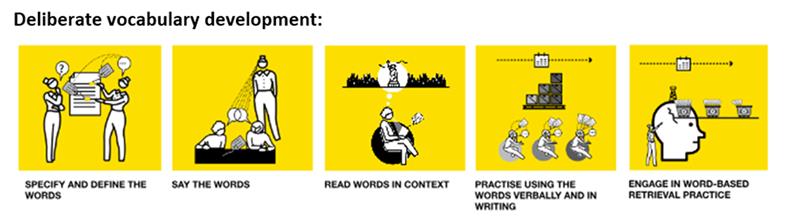
We explicitly teach and explore tiered vocabulary so that children not only encounter ambitious language but learn to understand, articulate and apply it confidently. Teachers plan vocabulary instruction within lessons, use coaching to refine practice, and evaluate impact to ensure that children are developing depth of understanding as well as breadth of word knowledge.
This systematic approach supports children to become confident communicators who can access the full curriculum, express themselves precisely and understand increasingly complex texts."
How can you help children with learning vocabulary at home?
Parents can play a huge role in helping children develop a strong vocabulary at home. Here’s a comprehensive approach, blending practical strategies, fun activities, and consistency:
1. Talk With Your Child Often
- Engage in regular conversations about daily activities, feelings, and experiences.
- Use rich, descriptive language instead of simple words. For example, say “The enormous, orange pumpkin is sitting on the porch” instead of “Look at the pumpkin.”
2. Read Together Daily
- Reading is one of the most effective ways to expose children to new words.
- Choose books slightly above their current reading level to introduce new vocabulary naturally.
- Ask questions about the story: “What do you think ‘curious’ means here?”
3. Play Word Games
- Scrabble or Boggle: Great for older kids.
- Word Bingo or Memory: Fun for younger kids.
- 20 Questions: Helps kids describe and think about words.
4. Use Vocabulary in Context
- Encourage children to use new words in sentences or during conversations.
- Example: If they learn “gigantic,” you might say, “Can you describe the gigantic tree outside?”
5. Label the Environment
- Label items around the house: “refrigerator,” “microwave,” “bookshelf,” etc.
- Visual reinforcement helps children remember new words.
6. Encourage Writing
- Journals, stories, or even shopping lists can help kids practice new vocabulary.
- Correct gently and introduce synonyms or richer words.
7. Use Technology Wisely
- Educational apps, audiobooks, and vocabulary-building websites can supplement learning.
- Make sure content is age-appropriate and interactive.
8. Model a Love of Words
- Use new words yourself and explain their meaning.
- Show excitement about learning words – kids often mimic adults’ enthusiasm.
9. Connect Words to Real Life
- When cooking, travelling, or doing chores, introduce related vocabulary.
- Example: Baking together—“mix,” “fold,” “knead,” “measure,” “ingredients.”
10. Be Patient and Consistent
- Vocabulary growth is gradual.
- Revisit words multiple times in different contexts to reinforce understanding.
Extra Tip: Keep a “Word Wall” or notebook at home where your child writes new words they encounter and adds definitions, drawings, or example sentences. This visual reference strengthens memory.
